
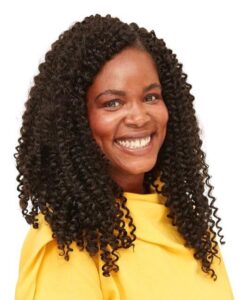
 Get to know Priscilla Akutu-Carter – Coach & Consultant
What’s been a defining moment for you as a woman in your career?
A year after adopting my daughter, I was in a demanding senior role at a global private bank, which was going through a merger. I was convinced I could excel at everything – ambitious career goals whilst embracing the role of a parent. My inherent perfectionist tendencies told me that I was a ‘modern working woman’ who had the capacity to manage it all. The reality? I was managing it all badly and felt constantly overwhelmed.
The struggle became a turning point. I realised I couldn’t do my role and home life the way I had before and something fundamental had to shift. I was confronted by a need to move beyond merely acknowledging that I needed support and summon the courage to ask for it. This meant adapting my working pattern and leaning on my immediate team, playing to their strengths, and letting go of control in ways that felt unfamiliar and uncomfortable at first.
What emerged was a better kind of leadership. Through delegation, giving my team real autonomy and trust, I discovered they could often handle things better than I could. If I wanted to grow professionally, whilst remaining an engaged parent, I would need help in all aspects of life. This experience fundamentally shaped how I think about sustainable performance, leadership, and the importance of building cultures where asking for support is acknowledged as a demonstration of strength, not as a weakness.
What’s your own experience of the Three Barriers and what tips would you give women navigating their own barriers?
I have undoubtably experienced the impact of three barriers in my career journey – whether consciously or unconsciously. Each of these barriers are further compounded by my intersectional identity. Earlier in my career, I was forced to contend with the characteristic of age, as I entered leadership positions as a young woman. When I became a parent, I experienced the impossible pull between wanting to excel professionally whilst being present at home. The organisational barriers meant that my demanding role wasn’t structured to support the changes in my life.
Whilst these societal, organisational and personal barriers exist, I recommend focusing on orchestrating change which is within your sphere of control or influence. There are several things that women can do in the workplace to advocate for themselves:
- Challenge the “superwoman” narrative. The societal pressure to do everything perfectly isn’t just unhelpful, it’s unachievable. Recognising this freed me to make different choices.
- Redesign rather than just manage. Don’t try to fit your new circumstances into old ways of working. This may require you to re-evaluate your pathway to progression, restructure your working day or embracing delegation and collaboration in ways that may feel uncomfortable to you initially.
- Build your support ecosystem intentionally. Whether it’s your immediate team, mentors, or peer networks, identify who can support different aspects of your work and life.
- Advocate for organisational change. When you encounter organisational barriers, if it is safe to do so, name them. Your experience can help reshape workplace structures for those coming after you.
What have you read recently and any top takeaway that our audiences might benefit from?
I’ve very recently revisited Viktor Frankl’s Man’s Search for Meaning, and it resonated deeply with culture change work. Frankl’s central insight: that we can’t always control our circumstances, but we can control our response to them, feels particularly relevant for individuals and organisations navigating change. His concept that meaning comes through purposeful work, authentic relationships, and how we face challenges offers a powerful framework for thinking about workplace culture. It’s a reminder that sustainable change isn’t just about new processes or structures; it’s about helping people find meaning and agency within their work, especially during uncertain times.
What do you like to do in your spare time?
A year ago, my family and I relocated to the coast, which is a move that has had a profound impact on our lives. I really enjoy walks and hikes and getting out into the great outdoors. We’re still enjoying the novelty of exploring our new area, so we spend a lot of time discovering new places – coastal walks, woods and the areas of natural beauty around us. I’ve always been interested in astronomy and recently joined my local astronomical society. I am far from an expert, but I am fascinated by the night sky and will jump at any opportunity to view constellations and planets through a telescope!
Do you face the double burden as a woman with a career and if so, how do you manage it?
This is a very interesting question. I have both an objective and subjective response to this. Objectively there is an ever-expanding body of empirical evidence that suggests that I may face challenges as a woman with a career. These challenges are further compounded by my role as a parent and a woman with an intersectional identity – objectively, the answer to the question is ‘yes’ – the evidence suggests that I am likely to experience a ‘double burden’. From a personal perspective, I feel very fortunate to have come of age at a time (and place) where the notion of a ‘career woman’ was commonplace. I believe that it is possible for both barriers and opportunities to co-exist and I have always found that good professional relationships have been central to my ability to navigate obstacles. I actively sought out female mentors and have always taken both comfort and inspiration from the many examples of women who navigate fulfilling careers.